You are about to leave the website of SDM Inc. ("SDM") and will be redirected to the website of SDM Financial Inc. ("SDM Financial"), a US affiliate of SDM providing crypto derivatives trading services.
Please be aware that SDM Financial's services are not intended for, and should not be used by, residents of Canada.
By clicking on the link to SDM Financial's website, you acknowledge and agree that: You are not a Canadian resident.
SDM Financial is not registered with any regulatory authority in Canada and is strictly prohibited from entering, or otherwise engaging in, any transactions with Canadian residents.
Non-Canadian residents who deal with SDM Financial do so at their own risk, and SDM will not be held liable for any losses or damages incurred as a result.
By clicking 'I Accept' below, you confirm that you have read, understand, and agree to the above . If you do not agree, please select 'I Decline' and you will be redirected back to SDM's website.
Bitcoin traded in a tight range around the $70,000 level heading into Thursday’s U.S. session as markets digested the latest macroeconomic data. Initial jobless claims came in at 213,000 for the week ending March 7, largely in line with expectations and only slightly below the previous week’s reading. The data reinforced the narrative that the U.S. labor market remains relatively stable, following Wednesday’s CPI release which also came in broadly as expected. With no major macro surprises, Bitcoin price action remained compressed as traders continue to wait for a clear directional catalyst.
At the same time, expectations for near term Federal Reserve policy remain firmly hawkish. According to CME FedWatch data, markets are now assigning less than a 1% probability of a rate cut at the upcoming March 18 FOMC meeting. The persistence of higher interest rate expectations has limited upside momentum across risk assets, including equities and digital assets, as investors continue to adjust to the possibility that monetary policy may remain restrictive for longer than previously anticipated.
Meanwhile, volatility in the energy markets continues to add an additional layer of uncertainty to the macro backdrop. Oil prices surged more than 5% on the day and briefly traded above $95 per barrel as geopolitical tensions in the Middle East intensified. Uncertainty surrounding the duration of the conflict and potential disruptions to global energy supply have kept crude markets extremely sensitive to new developments. Even reports of a coordinated release of roughly 400 million barrels from strategic reserves did little to ease the upward pressure on prices.
From a market structure perspective, Bitcoin remains locked within a clearly defined trading range. Many traders are currently watching the $72,000 level as key resistance while the $62,000 region continues to serve as a broader support zone. With the point of control near $68,000, price action within this band may continue to remain choppy until a stronger catalyst emerges. Historically, consolidations of this nature can persist for several weeks before resolving into a more decisive directional move.
Private credit markets are also showing early signs of stress beneath the surface. U.S. private credit defaults reached 9.2% in 2025, more than double the 4.5% default rate observed in broadly syndicated loans. The pressure appears concentrated among smaller borrowers, with companies generating less than $25M in EBITDA defaulting at nearly 4x the rate of larger issuers. One example circulating in credit markets is a stressed loan tied to “Project Leopard,” which is currently trading at a yield nearly double where it began 2026. In response to the shifting risk environment, JPMorgan has reportedly marked down certain private credit exposures and restricted lending to some private credit funds. Despite the rising default rate, realized losses for lenders have remained relatively contained so far, as many first lien recoveries are still coming back close to par.
For now, Bitcoin appears to be stabilizing near the $70,000 region while macro forces continue to shape market sentiment. The interaction between elevated oil prices, persistent geopolitical risk, tightening financial conditions, and emerging stress in private credit markets will likely remain important drivers for broader risk assets as investors assess whether markets can maintain stability or move toward a more volatile phase.
Crypto Charts
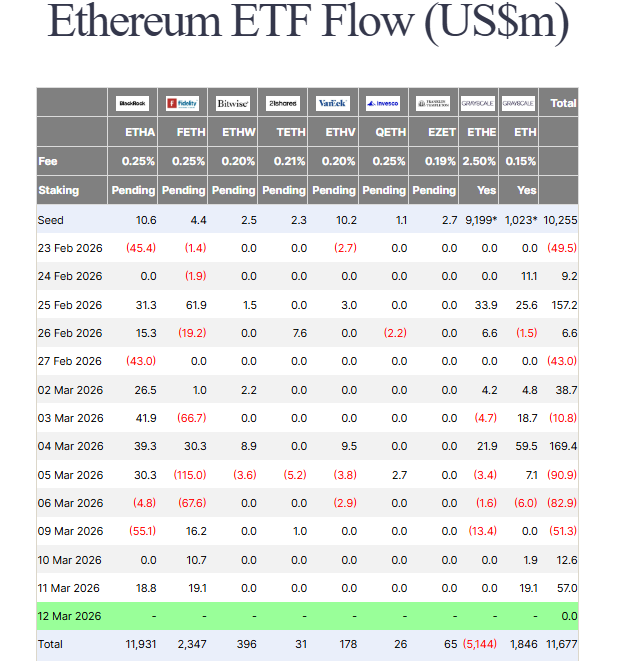
ETF Flow
Disclaimer
This research is for informational use only. This is not investment advice. Other than disclosures relating to Secure Digital Markets this research is based on current public information that we consider reliable, but we do not represent it is accurate or complete, and it should not be relied on as such. The information, opinions, estimates, and forecasts contained herein are as of the date hereof and are subject to change without prior notification. We seek to update our research as appropriate.
Any forecasts contained herein are for illustrative purposes only and are not to be relied upon as advice or interpreted as a recommendation. The price of crypto assets may rise or fall because of changes in the broad market or changes in a company's financial condition, sometimes rapidly or unpredictably. Past performance is not a guide to future performance, future returns are not guaranteed, and a loss of original capital may occur. Fluctuations in exchange rates could have adverse effects on the value or price of, or income derived from, certain investments. We and our affiliates, officers, directors, and employees, excluding equity and credit analysts, will from time to time have long or short positions in, act as principal in, and buy or sell, the securities or derivatives, if any, referred to in this research.
The information on which the analysis is based has been obtained from sources believed to be reliable such as, for example, the company’s financial statements filed with a regulator, company website, company white paper, pitchbook and any other sources. While Secure Digital Markets has obtained data, statistics, and information from sources it believes to be reliable, it does not perform an audit or seek independent verification of any of the data, statistics, and information it receives.
Unless otherwise provided in a separate agreement, Secure Digital Markets does not represent that the report contents meet all of the presentation and/or disclosure standards applicable in the jurisdiction the recipient is located. Secure Digital Markets and their officers, directors and employees shall not be responsible or liable for any trading decisions, damages or other losses resulting from, or related to, the information, data, analyses, or opinions within the report.
Crypto and/or digital currencies involve substantial risk, are speculative in nature and may not perform as expected. Many digital currency platforms are not subject to regulatory supervision, unlike regulated exchanges. Some platforms may commingle customer assets in shared accounts and provide inadequate custody, which may affect whether or how investors can withdraw their currency and/or subject them to money laundering. Digital currencies may be vulnerable to hacks and cyber fraud as well as significant volatility and price swings.
Contact Us
Sign up to receive more exclusive market coverage: